
📊 Learn Technical Analysis
- What is Technical Analysis?
- What is Candlestick?
- Different types of Candles.
- Different types of chart patterns.
- What is reversal patterns?
- What is Indicators?
- What is RSI Indicators?
📈What is Technical Analysis?
Technical analysis is used to analyze behavior of a stock and indices for short term to long term. It helps traders and investor to predict the price of a share from short term to long term. Technical analysis is a powerful method used by traders to analyze market trends and make informed decisions. One of the most fundamental concepts in technical analysis is candlestick charts. Understanding candlesticks can give traders critical insights into market sentiment, helping them predict potential price movements. In this article, we’ll dive into the basics of candlesticks, the different types of candles, and the chart and reversal patterns that traders use to spot potential market turning points.
Technical analysis is the study of past market data, primarily price and volume, to predict future price movements. Unlike fundamental analysis, which focuses on a company’s financial health, technical analysis is all about charts, patterns, and indicators.
Traders use technical analysis to:
- Identify entry and exit points
- Spot trends and reversals
- Analyze support and resistance levels
- Make informed decisions based on market psychology
What is a Candlestick?
A candlestick is a visual representation of price movement within a specified period on a chart, often used in financial markets to show the open, high, low, and close (OHLC) prices of an asset during a set timeframe. candles time interval can vary from seconds. minutes, hour, daily, weekly to monthly.
Short term Chart Frame: 5 min. to 15 min. time interval. it is generally used in intraday trading
Medium Term chart Frame: 1 hour to 1 day. it is used in swing trading and short term technical analysis
Long Term Chart Frame: Daily, weekly and monthly candles. these are used for medium to long technical analysis.
Each candlestick consists of:
- Body: The body of the candlestick represents the difference between the opening and closing prices. If the close price is higher than the open, the body will typically be hollow or colored green/white (bullish). If the close price is lower than the open, the body will be filled or colored red/black (bearish).
- Wicks (or Shadows): The thin lines above and below the body are the wicks, also called shadows. These show the highest and lowest prices during the timeframe represented by the candlestick.
- Upper wick: The line above the body shows the highest price.
- Lower wick: The line below the body shows the lowest price.
- Color: Usually green (price went up) or red (price went down)
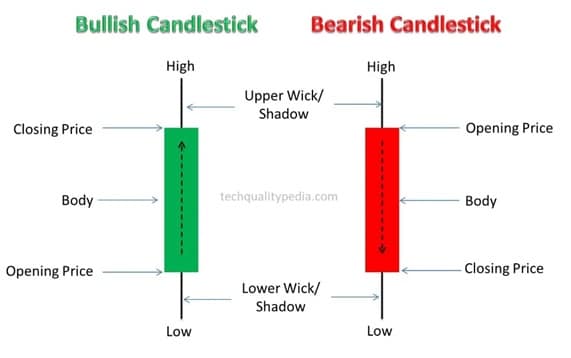
By analyzing the candlestick patterns, traders can gain insights into potential market direction and momentum.
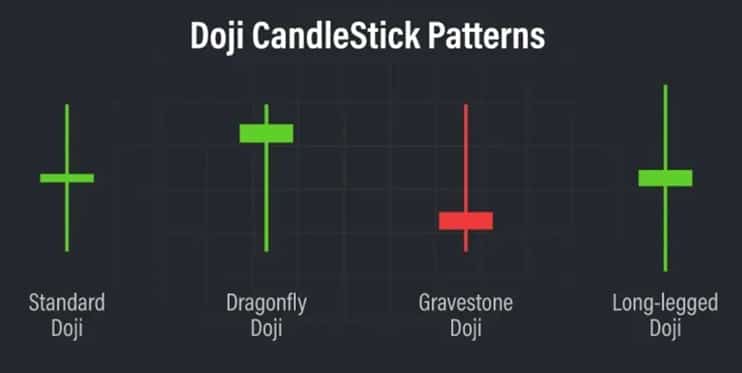
Doji Candle :
Doji candlestick represents indecision in the market. It forms when the opening and closing prices are virtually the same, creating a very small or nonexistent body. Full body candles indicates trend of market while dogi candles represent indecision.
🔥 Types of Candlestick Patterns
🔹 1. Bullish Candlestick Patterns
These indicate that the stock price might go up.
✅ a) Hammer
- Small body, long lower wick
- Appears after a downtrend
- Signals a possible reversal to the upside
✅ b) Bullish Engulfing
- A small red candle followed by a larger green candle
- The green candle fully engulfs the red one
- Strong bullish reversal pattern
✅ c) Morning Star
- Three candles: red → small-bodied (doji/spinning top) → large green
- Appears after a downtrend
- Indicates buying pressure is building
🔹 2. Bearish Candlestick Patterns
These suggest the price might fall.
❌ a) Shooting Star
- Small body, long upper wick
- Appears after an uptrend
- Sign of possible reversal to downside
❌ b) Bearish Engulfing
- A small green candle followed by a big red candle
- Red candle engulfs the previous green one
- Strong bearish reversal signal
❌ c) Evening Star
- Three candles: green → small-bodied → large red
- Appears at the top of an uptrend
- Indicates potential for selling pressure
🔹 3. Neutral or Indecision Patterns
These suggest uncertainty in the market.
⚖️ a) Doji
- Open and close are almost the same
- Looks like a plus sign
- Signals indecision; trend reversal possible if at peak or bottom
⚖️ b) Spinning Top
- Small body, long upper and lower wicks
- Indicates lack of strong direction
📊Different Types of Charts Patterns
Chart patterns are formations created by the price movements on a candlestick chart. They are essential for understanding the psychology of market participants. Here are a few important chart patterns:
1. Head and Shoulders
This is a reversal pattern that indicates a trend change. The “Head and Shoulders” pattern consists of three peaks: a higher peak (head) between two lower peaks (shoulders). It signals that an uptrend may be about to reverse into a downtrend when the price breaks below the “neckline” of the pattern.
- Inverse Head and Shoulders: The inverse pattern signals a potential upward reversal after a downtrend.
2. Triangles
- Symmetrical Triangle: A consolidation pattern that forms when the price moves between converging trendlines, indicating indecision in the market. A breakout in either direction (up or down) can indicate the next move.
- Ascending Triangle: A bullish pattern with a flat upper trendline and an upward-sloping lower trendline. It suggests the price is more likely to break out to the upside.
- Descending Triangle: A bearish pattern where the upper trendline is flat and the lower trendline slopes downward, often signaling a downward breakout.
3. Double Top and Double Bottom
- Double Top: A bearish reversal pattern that forms when an asset hits a peak twice, with a moderate decline in between. It indicates that the uptrend may be ending and a price drop could follow.
- Double Bottom: A bullish reversal pattern that occurs after a downtrend, where the asset hits a bottom twice and then starts to rise. It suggests that the price may reverse upward.
Different Types of Reversal Patterns
Reversal patterns are formations that indicate a change in the direction of the market trend. Recognizing these patterns can help traders spot trend reversals early.
1. Morning Star & Evening Star
- Morning Star: A bullish reversal pattern consisting of three candles: a long bearish candle, followed by a small-bodied candle (which could be a Doji), and a long bullish candle. It signals the end of a downtrend and the beginning of an uptrend.
- Evening Star: The opposite of the Morning Star, this pattern suggests a potential reversal from an uptrend to a downtrend.
2. Piercing Line
A Piercing Line pattern is a bullish reversal pattern where a long bearish candlestick is followed by a long bullish candlestick that opens below the previous low but closes above the midpoint of the previous candle’s body.
3. Dark Cloud Cover
A Dark Cloud Cover is a bearish reversal pattern formed when a large bullish candlestick is followed by a bearish candlestick that opens above the previous high and closes below the midpoint of the previous candlestick’s body.
Learn Technical Analysis: Different Types of Indicators and How They Work
Technical analysis isn’t just about reading charts and recognizing patterns; it also involves using indicators—tools that help traders analyze price movements and market trends. Indicators are mathematical calculations based on historical price and volume data. They are essential for identifying trends, momentum, volatility, and market strength.
In this article, we’ll explore the different types of indicators in technical analysis and how they work.
What are Technical Indicators?
Technical indicators are mathematical formulas applied to price and volume data on a chart. They are used to identify potential trading opportunities by analyzing past price movements and market conditions. Traders use indicators to help predict future price trends, spot reversal points, and assess the strength of a trend.
Indicators can be categorized into different types based on the market aspect they analyze, such as trend-following, momentum, volatility, and volume-based indicators. Let’s dive into the most common types of indicators and how they work.
1. Trend Indicators
Trend indicators are designed to identify the direction of the market, helping traders determine whether the market is in an uptrend, downtrend, or moving sideways. These indicators are particularly useful for traders who want to follow the prevailing market trend.
Moving Averages (MA)
Moving averages are the most widely used trend indicators. A moving average is calculated by averaging the closing prices of an asset over a specified period.
- Simple Moving Average (SMA): The average of a specific number of closing prices over a given period. For example, a 50-day SMA calculates the average closing price over the last 50 days.
- Exponential Moving Average (EMA): A type of moving average that gives more weight to the most recent prices, making it more responsive to price changes than the SMA.
The crossing of shorter-period moving averages above longer-period moving averages is often interpreted as a bullish signal (indicating a potential uptrend), and vice versa, when a shorter-period moving average crosses below a longer-period moving average, it’s seen as a bearish signal.
Average Directional Index (ADX)
The ADX measures the strength of a trend without indicating whether it’s bullish or bearish. It ranges from 0 to 100. A value above 25 indicates a strong trend, while below 20 suggests a weak or no trend.
- ADX above 25: Strong trend, whether bullish or bearish.
- ADX below 20: Weak or no trend.
2. Momentum Indicators
Momentum indicators help traders evaluate the speed and strength of a price movement. These indicators measure whether an asset is overbought or oversold, signaling potential reversal points.
Relative Strength Index (RSI)
The RSI is one of the most popular momentum indicators. It measures the speed and change of price movements on a scale from 0 to 100. RSI helps identify overbought or oversold conditions in the market.
- RSI above 70: Overbought (potentially overvalued, signaling a reversal or correction).
- RSI below 30: Oversold (potentially undervalued, signaling a buying opportunity).
Stochastic Oscillator
The Stochastic Oscillator compares an asset’s closing price to its price range over a given time period. It is plotted between 0 and 100, with readings above 80 indicating overbought conditions, and readings below 20 indicating oversold conditions.
The stochastic indicator consists of two lines:
- %K Line: The faster line, which represents the current closing price relative to the high-low range over a set period.
- %D Line: The slower moving average of the %K line.
Traders look for crossovers between these lines to signal potential buy or sell opportunities.
3. Volatility Indicators
Volatility indicators measure the degree of price fluctuation in the market. These indicators are important because high volatility often signals significant price moves, which can create trading opportunities.
Bollinger Bands
Bollinger Bands consist of three lines:
- Middle Band: A moving average (typically a 20-period SMA).
- Upper Band: The middle band plus two standard deviations.
- Lower Band: The middle band minus two standard deviations.
When the price reaches the upper band, the market is considered overbought, and when it touches the lower band, the market is considered oversold. Narrow bands indicate low volatility, while wide bands indicate high volatility.
Traders use Bollinger Bands to identify potential breakouts or breakdowns. A sharp move outside of the bands often signals the start of a significant price movement.
Average True Range (ATR)
The ATR measures market volatility by calculating the average range between the high and low prices over a set period. A high ATR value indicates higher volatility, while a low ATR suggests less price movement.
Traders often use ATR to adjust their stop-loss levels or to assess whether a market is ripe for breakout or breakdown strategies.
4. Volume Indicators
Volume is a crucial factor in understanding price movements, as it shows the strength or weakness behind a move. Volume indicators help traders confirm trends and spot potential reversals.
On-Balance Volume (OBV)
OBV is a volume-based indicator that relates volume to price change. It adds volume on days when the price closes higher and subtracts volume on days when the price closes lower.
- Rising OBV: Indicates accumulation or buying pressure.
- Falling OBV: Indicates distribution or selling pressure.
OBV helps traders confirm trends; for example, if the price is rising, and OBV is also rising, it signals that the upward trend is supported by strong buying volume.
Chaikin Money Flow (CMF)
The Chaikin Money Flow indicator measures the volume-weighted average price over a specified period. It shows the buying and selling pressure based on both price and volume.
- CMF above 0: Indicates buying pressure (bullish).
- CMF below 0: Indicates selling pressure (bearish).
5. Oscillators
Oscillators are indicators that move within a bounded range (usually between 0 and 100), helping traders identify overbought or oversold conditions.
Commodity Channel Index (CCI)
The CCI measures the deviation of an asset’s price from its average price over a specified period. A high positive value (above +100) signals overbought conditions, while a low negative value (below -100) signals oversold conditions.
- CCI above +100: Overbought (potential sell signal).
- CCI below -100: Oversold (potential buy signal).
Moving Average Convergence Divergence (MACD)
The MACD is a trend-following momentum indicator that shows the relationship between two moving averages (usually the 12-day EMA and the 26-day EMA). It consists of:
- MACD Line: The difference between the 12-day and 26-day EMAs.
- Signal Line: A 9-day EMA of the MACD line.
Traders use crossovers between the MACD line and the signal line as buy or sell signals. The MACD can also be used to identify divergence with price, which often signals potential reversals.
What is the Relative Strength Index (RSI)?
The Relative Strength Index (RSI) is a popular momentum oscillator that measures the speed and change of price movements. It is used by traders to identify overbought or oversold conditions in a market, helping them predict potential price reversals.
The RSI was developed by J. Welles Wilder in 1978 and is one of the most widely used indicators in technical analysis.
The RSI ranges from 0 to 100 and is typically displayed beneath a price chart. It is calculated using the following formula:
RSI=100−100/(1+RS)
Where RS (Relative Strength) is the average of “n” days’ up closes divided by the average of “n” days’ down closes, typically calculated over a 14-period (can be adjusted).
RS=Average Gain/Average Loss
How Does RSI Work?
- RSI above 70: The market is considered overbought. This means that the asset may have risen too quickly and could be due for a price correction or reversal. Traders may look for potential selling opportunities when the RSI enters this zone.
- RSI below 30: The market is considered oversold. This suggests that the asset may have fallen too sharply and could be due for a rebound or reversal. Traders may consider buying when the RSI enters this zone.
- RSI between 30 and 70: The market is considered to be in a neutral zone where there isn’t enough momentum for an immediate trend reversal. Traders will often look for other signals or use the RSI in conjunction with other indicators to make trading decisions.
Interpreting RSI Values
- Overbought and Oversold Conditions: The most common use of RSI is to spot overbought or oversold conditions.
- Overbought (above 70): When the RSI moves above the 70 level, the asset is considered to be overbought, meaning it may be overpriced and a correction or price pullback could be imminent.
- Oversold (below 30): When the RSI moves below the 30 level, the asset is considered to be oversold, indicating it may be underpriced and a price rebound could be coming.
- Bullish Divergence: This occurs when the price is making new lows, but the RSI is making higher lows. It indicates that despite the downward price action, momentum is weakening, and a bullish reversal may be imminent.
- Bearish Divergence: This occurs when the price is making new highs, but the RSI is making lower highs. This indicates that despite the upward price movement, momentum is fading, and a bearish reversal could follow.
RSI Signals and Trading Strategies
1. Overbought and Oversold Conditions
Traders often use the overbought and oversold levels to identify potential reversal points. Here’s how they apply:
- Buy Signal: When the RSI falls below 30 (oversold) and then rises back above this level, it can signal a potential buying opportunity, suggesting that the price may start to rebound.
- Sell Signal: When the RSI rises above 70 (overbought) and then falls back below this level, it can signal a potential selling opportunity, suggesting that the price may start to decline.
2. RSI Divergence
Divergence between the price action and the RSI is a strong signal of potential trend reversal. There are two types of divergence:
- Bullish Divergence: This occurs when the price is in a downtrend, but the RSI forms higher lows, indicating that the selling pressure is weakening, and the market could reverse upwards.
- Bearish Divergence: This occurs when the price is in an uptrend, but the RSI forms lower highs, indicating that the buying pressure is weakening, and the market could reverse downwards.
3. RSI Trendline Breaks
Another popular strategy is drawing trendlines on the RSI chart. If the RSI forms a trendline (either upward or downward) and then breaks through that trendline, it may signal a trend reversal in price as well.
For example:
- If RSI is forming higher highs but then breaks below the trendline, this may indicate a bearish reversal.
- If RSI is forming lower lows but then breaks above the trendline, this may indicate a bullish reversal.
RSI Settings and Customization
- The default period for calculating RSI is 14 periods, but traders can adjust this value depending on their trading strategy. Shorter periods (e.g., 7 or 9) will make the RSI more sensitive, and it will generate more signals (but may also increase noise). Longer periods (e.g., 21 or 30) will make the RSI smoother, and the signals will be less frequent but potentially more reliable.
- Overbought and Oversold Levels: While the default levels for overbought and oversold conditions are 70 and 30, respectively, traders can adjust these levels depending on the asset’s volatility and market conditions. Some traders prefer using 80/20 for more volatile markets.
RSI Limitations
While the RSI is a powerful tool, it’s important to remember that it has limitations:
- False Signals: RSI can generate false signals, particularly in strong trending markets. In a strong uptrend, the RSI may remain overbought (above 70) for extended periods, and in a strong downtrend, it may remain oversold (below 30) for extended periods. Traders need to be cautious when using RSI in trending markets.
- Lagging Indicator: Like most technical indicators, the RSI is a lagging indicator, meaning it is based on historical price data. This means RSI signals may occur after a price movement has already started.
- No Confirmation of Trend Direction: The RSI does not indicate the direction of the trend; it only signals overbought and oversold conditions. Traders often use RSI in combination with other indicators (like moving averages or trend lines) to confirm the trend’s direction.
RSI in Practice: Example
Let’s walk through an example of how the RSI might be used in practice:
- Scenario 1: Overbought Condition
- Suppose a stock has been rising steadily for several days. The RSI reaches 75, indicating that the stock is overbought. Traders might anticipate that the price could soon pull back. When the RSI falls below 70 (after reaching its peak), they might enter a short position or take profits on a long trade.
- Scenario 2: Bullish Divergence
- Let’s say a stock is in a downtrend, and the price hits a new low. However, the RSI forms a higher low, signaling that the downward momentum is weakening. This could be an early indication that the stock might reverse to the upside, prompting traders to look for a buying opportunity.